
BGP next hop self configuration example

BGP next hop self configuration example:

[boxads]Today i will discuss bgp next hop self configuration example in cisco router. When any router receive BGP route from eBGP  source & forward it any iBGP peer, then BGP normally pass directly connected next hop ip address.  To overcome this issue, we use next hop self command in BGP section at the entry point router which router is directly connected to eBGP peer.

neighbor {ip-addr | group-name } next-hop-self

Let’s take an example.

BGP next hop self configuration example Diagram:
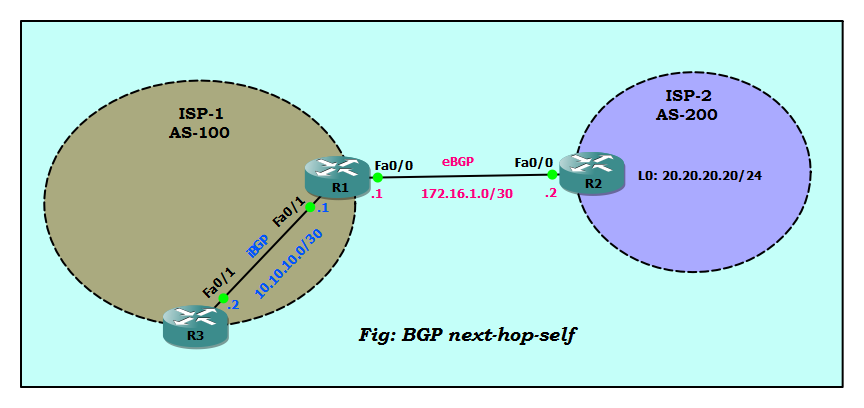
BGP next hop self configuration example

In this diagram we look Two ISP connected via eBGP peer & ISP-1 has a internal iBGP peer. Here R1 & R3 use 10.10.10.0/30 network ip, R1 & R2 use 172.16.1.0/30 network ip. Also test purpose we add a loopback ip in R2 router that is 20.20.20.20/24. When ISP-2 Router R2 advertise its network 20.20.20.0/24, next hop ip address will be 172.16.1.2 (its fa0/0 interface of R2 router). ISP-1 Router R1 advertise this network to iBGP peer router R3 with the same 172.16.1.2 next hop attribute. Let’s configure those routers, but won’t change next hop attribute for now.
Read more

BGP Multihoming with Two Different ISP

BGP Multihoming:

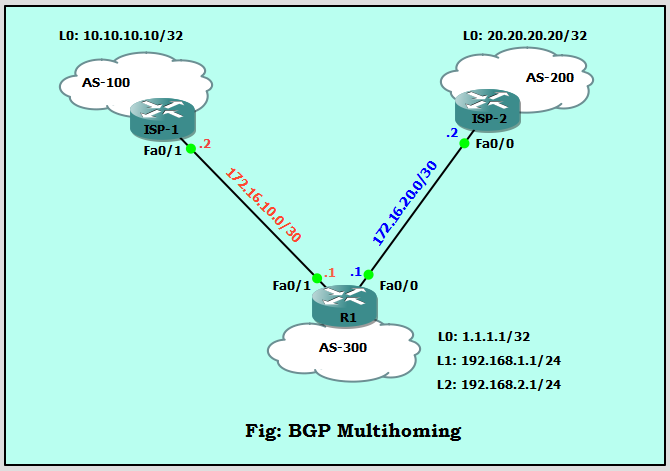
[boxads]Today i will discuss how to configure BGP Multihoming with Two Different Service Providers environment. When you connect your network to two different Internet service providers (ISPs), it is called multihoming. Multihoming provides redundancy and network optimization. It selects the ISP which offers the best path to a resource. So let’s follow our diagram:

BGP Multihoming
BGP Multihoming

Here Router R1 upstream are connected to two ISP’s. one is ISP-1 and AS is 100, another is ISP-2 and it’s AS is 200. Now let’s go our BGP Multihoming configuration part.

Read more

eBGP load balancing with single-homed BGP environment

eBGP load balancing :

[boxads]Today i will discuss how to configure eBGP load balancing with single-homed BGP environment. So lets go…….. If we look our topology we see here two ISP router are connected through two link.  Also this two router are in different autonomous system. Router R1 autonomous system is 21 & Router R2 autonomous system is 22.

Router R1 loopback address: 1.1.1.1  & 11.11.11.11

Router R2 loopback address: 2.2.2.2 & 12.12.12.12

Also this loopback0 are connected via static route & loopback1 connected via eBGP.

eBGP load balancing Network Diagram:

eBGP load balancing
eBGP load balancing

This scenario shows how to achieve load balancing when there are multiple (up to a maximum of six), equal-cost links. The links are terminated in one router at a local autonomous system (AS) and in another router at a remote AS in a single-homed BGP environment. Now we will be start our configuration part.

Router R1 Configuration:

Basic IP Configure:

R1#configure terminal
R1(config)#interface loopback 0
R1(config-if)#ip address 1.1.1.1 255.255.255.255
R1(config)#interface loopback 1
R1(config-if)#ip address 11.11.11.11 255.255.255.0
R1(config-if)#int fa0/0
R1(config-if)#ip address 10.10.0.1 255.255.255.0
R1(config-if)#no shutdown
R1(config-if)#int fa0/1
R1(config-if)#ip address 10.10.1.1 255.255.255.0
R1(config-if)#no shutdown
R1(config-if)#

Read more

BGP update source loopback0 commands

BGP update source loopback0:

[boxads]Today i will discuss why we use BGP update source loopback0 for establishing  neighbor relationship between bgp peering. If we have two paths between BGP neighbors, then which path use to establish neighbor relationship? don’t worry i will describe you briefly, please look bellow diagram:

BGP update source loopback0

In this topology we see that there are two links between router R1 and router R2. We can establish two neighbor relationships, on both paths, but this is not a good solution. So, we’ll establish only one neighbor ship with each other. BGP gives us an option to change the source of packets sent. In this case we can use Loopback interface as source of BGP packets sent between these neighbors. By using  a loopback interface as source interface we have two paths between them, if one of paths fails, the other one will be used.

Read more

BGP Regular Expressions Cheat Sheet

BGP Regular Expressions Cheat Sheet

Regular expressions are strings of special characters that can be used to search and find character patterns. Within the scope of BGP in Cisco IOS regular expressions can be used in show commands and AS-Path access-lists to match BGP prefixes based on the information contained in their AS-Path. [boxads]

In order to understand how to build regular expressions we first need to know what the character definitions are for the regex function of IOS. The below table illustrates the regex characters and their usage. This information is contained in the Cisco IOS documentation under the Appendix of Cisco IOS Terminal Services Configuration Guide, Release 12.2.

BGP Regular Expressions Cheat Sheet:

BGP Regular Expressions Cheat Sheet

To find all subnets originating from AS 100 (AS path ends with 100):

Read more

BGP Best Path Selection Algorithm Cisco

BGP Best Path Selection Algorithm Cisco router

BGP is the protocol used to announce prefixes throughout the internet. It’s a very robust protocol, and very useful to carry lot of prefixes, such as the Internet prefixes or internal client prefixes of an ISP. BGP Best Path Selection Algorithm Cisco router when a prefix is received in BGP, the path passes through two steps before being chosen as candidate to populate the RIB.[boxads]

The first step consists on checking if the path is valid. If it is, the prefix will get into the BGP table, and later the second step of selection will start.

In order to pass this first check, the path must meet the following requirements:

  • The prefix must not been marked as “not-synchronized”
  • There must be a route in the RIB to reach the next-hop
  • For prefixes learned through eBGP sessions, the local ASN must not be in the AS_PATH of the prefix

In the second step, the best path to reach the prefix is selected. If there is only one path, no comparison needed. If there are many paths to reach the prefix, there is a special algorithm that BGP uses to select the best path, and this is what I want to talk about.

Read more