MPLS VPN Components basic knowledge

MPLS VPN Components:

Today I will discuss about MPLS VPN Components. It is same as MP-BGP Components. only extra Label component are added with MPLS VPN Components. [boxads]

  • RD: Route Distinguisher
  • VPNv4 routes
  • RT: Route Target
  • Label
MPLS VPN Components
MPLS VPN Components

VPNv4 address:

  • To convert an IPv4 address into a VPNv4 address, RD is appended to the IPv4 address i.e 1:1:10.1.1.0 Makes the customer’s IPv4 route globally unique.
  • Each VRF must be configured with an RD at the PE. RD is what that defines the VRF   [adsense]

Example:

ip vrf v1
rd 1:1

Read more

Virtual Routing and Forwarding basics (VRF)

Virtual Routing and Forwarding basics (VRF):

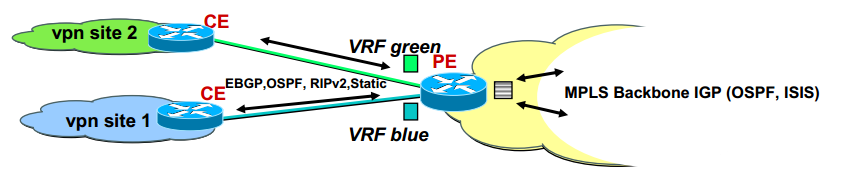
Today i will discuss about Virtual Routing and Forwarding basics (VRF). VRF is a Layer 3 VPN technique. VRF can be use with or without MPLS.  If we look bellow diagram we see here two VRF one is green VRF and another is blue VRF. [boxads]

Virtual Routing and Forwarding basics (VRF) Diagram:

Virtual Routing and Forwarding basics (VRF)

Now one question what is VRF ?

  • VRF associates to one or more interfaces on PE.
  • Privatize an interface. [i.e. coloring of the interface in diagram]
  • Has its own routing table and forwarding table (CEF)
  • VRF has its own instance for the routing protocol (static ,RIP,BGP,EIGRP,OSPF)
  • CE router runs standard routing software
  • PE installs the routes, learned from CE routers, in the appropriate VRF routing table(s)
  • Also PE installs the IGP (backbone) routes in the global routing table
  • VPN customers can use overlapping IP addresses.

Read more

MPLS VPN Connectivity diagram

MPLS VPN Connectivity diagram:

Today i will discuss about MPLS VPN Connectivity diagram or how a MPLS VPN domain buildup in service provider environment. [boxads]

MPLS VPN domain are consist mainly P & PE router.  P router means provider router, and PE router means provider edge router. P router are only forwarded Level & PE router collect & distribute customer prefixes. If we look bellow diagram we see P & PE router how connected.

MPLS VPN Connectivity diagram:

MPLS VPN Connectivity diagram

Read more

BGP Regular Expressions Cheat Sheet

BGP Regular Expressions Cheat Sheet

Regular expressions are strings of special characters that can be used to search and find character patterns. Within the scope of BGP in Cisco IOS regular expressions can be used in show commands and AS-Path access-lists to match BGP prefixes based on the information contained in their AS-Path. [boxads]

In order to understand how to build regular expressions we first need to know what the character definitions are for the regex function of IOS. The below table illustrates the regex characters and their usage. This information is contained in the Cisco IOS documentation under the Appendix of Cisco IOS Terminal Services Configuration Guide, Release 12.2.

BGP Regular Expressions Cheat Sheet:

BGP Regular Expressions Cheat Sheet

To find all subnets originating from AS 100 (AS path ends with 100):

Read more

BGP Best Path Selection Algorithm Cisco

BGP Best Path Selection Algorithm Cisco router

BGP is the protocol used to announce prefixes throughout the internet. It’s a very robust protocol, and very useful to carry lot of prefixes, such as the Internet prefixes or internal client prefixes of an ISP. BGP Best Path Selection Algorithm Cisco router when a prefix is received in BGP, the path passes through two steps before being chosen as candidate to populate the RIB.[boxads]

The first step consists on checking if the path is valid. If it is, the prefix will get into the BGP table, and later the second step of selection will start.

In order to pass this first check, the path must meet the following requirements:

  • The prefix must not been marked as “not-synchronized”
  • There must be a route in the RIB to reach the next-hop
  • For prefixes learned through eBGP sessions, the local ASN must not be in the AS_PATH of the prefix

In the second step, the best path to reach the prefix is selected. If there is only one path, no comparison needed. If there are many paths to reach the prefix, there is a special algorithm that BGP uses to select the best path, and this is what I want to talk about.

Read more

BGP MED Attribute Configuration example

BGP MED Attribute Configuration example

BGP MED Attribute Configuration example BGP MED is an optional non-transitive attribute meaning its not propagated throughout the whole internet but just to adjacent AS. The word “optional” means that this is not necessarily by default sent with the BGP updates. The purpose of MED is to influence how other autonomous systems enter your AS to reach a certain prefix. If the other attributes are set to default, MED will be the attribute used for path selection however, if Weight or Local preference is configured on the adjacent AS router, then MED will not be selected. The lower MED is more preferred. [boxads]

  • Acronym for Multi Exit Discriminator and otherwise known as “Metric” in the BGP table.
  • The lower the MED the more preferred.
  • It is an optional non-transitive attribute.
  • Can dictate how other AS enter your AS.
BGP MED Attribute Configuration example

Configure R4 so that it will advertise a MED value of 30 to R3 and 20 to R2. Afterwards, tweak the route map to set a MED of 10 for network 144.144.144.144/32 in R4 towards R3. The end result should have traffic from AS123 to 4.4.4.4/32 and 44.44.44.44/32 take R2 but traffic for 144.144.144.144/32 should take R3. At the start BGP has been established on all routers.

Read more