DMVPN Configuration Example:
In the DMVPN Overview article We explained how DMVPN combines a number of technologies that give it its flexibility, low administrative overhead and ease of configuration. This article will cover the DMVPN Configuration including Hub, Spokes, Routing and Protecting the mGRE Tunnel.[boxads]
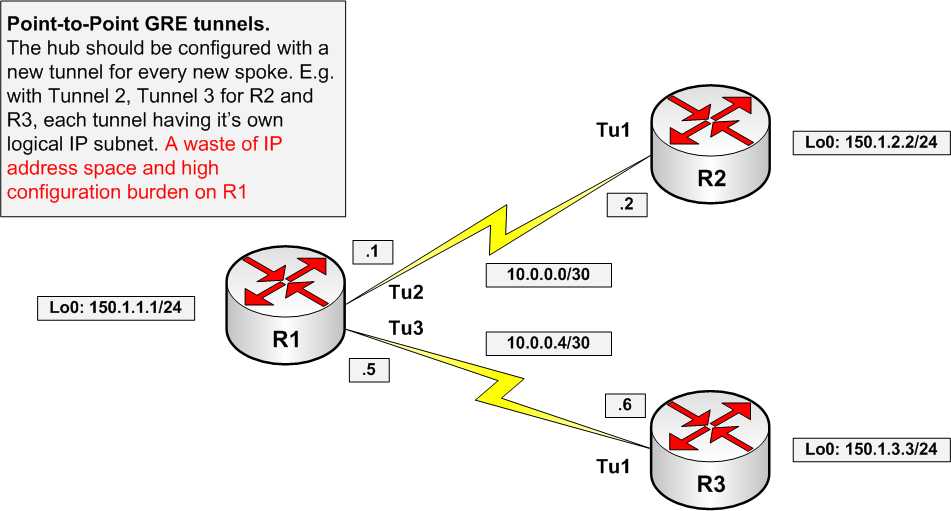
DMVPN Configuration is simple, if you’ve worked with GRE tunnels before. If the GRE Tunnel concept is new to you, we would recommend reading through our Point-to-Point GRE IPSec Tunnel Configuration article before proceeding with DMVPN configuration.
DMVPN as a design concept is essentially the configuration combination of protected GRE Tunnel and Next Hop Routing Protocol (NHRP).
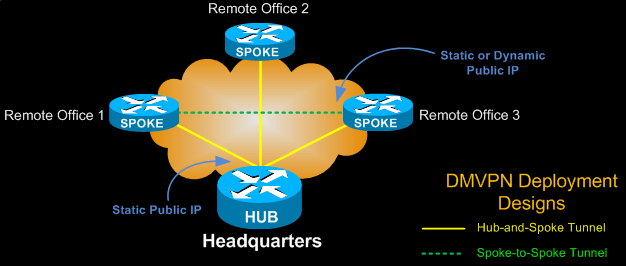
This article examines a specific DMVPN deployment architecture. Those seeking additional information on available DMVPN deplyment models can also visit my Dynamic Multipoint VPN DMVPN Architecture article.
DMVPN Operation – How DMVPN Operates:
Before diving into the configuration of our routers, we’ll briefly explain how the DMVPN is expected to work. This will help in understanding how DMVPN operates in a network:
- Each spoke has a permanent IPSec tunnel to the hub but not to the other spokes within the network.
- Each spoke registers as a client of the NHRP server. The Hub router undertakes the role of the NHRP server.
- When a spoke needs to send a packet to a destination (private) subnet on another spoke, it queries the NHRP server for the real (outside) address of the destination (target) spoke.
- After the originating spoke learns the peer address of the target spoke, it can initiate a dynamic IPSec tunnel to the target spoke.
- The spoke-to-spoke tunnel is built over the multipoint GRE (mGRE) interface.
- The spoke-to-spoke links are established on demand whenever there is traffic between the spokes. Thereafter, packets are able to bypass the hub and use the spoke-to-spoke tunnel.
- All data traversing the GRE tunnel is encrypted using IPSecurity (optional)
Our DMVPN Network:
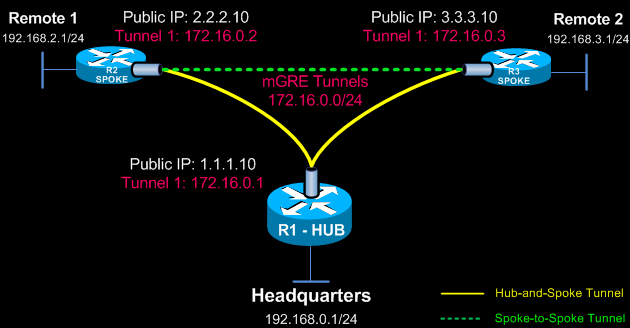
The diagram below depicts our DMVPN example network. Our goal is to connect the two remote networks (Remote 1 & 2) with the company headquarters. The headquarters router R1 is the central Hub router that will hold the NHRP database containing all spoke routers, their public IP addresses and LAN networks.